
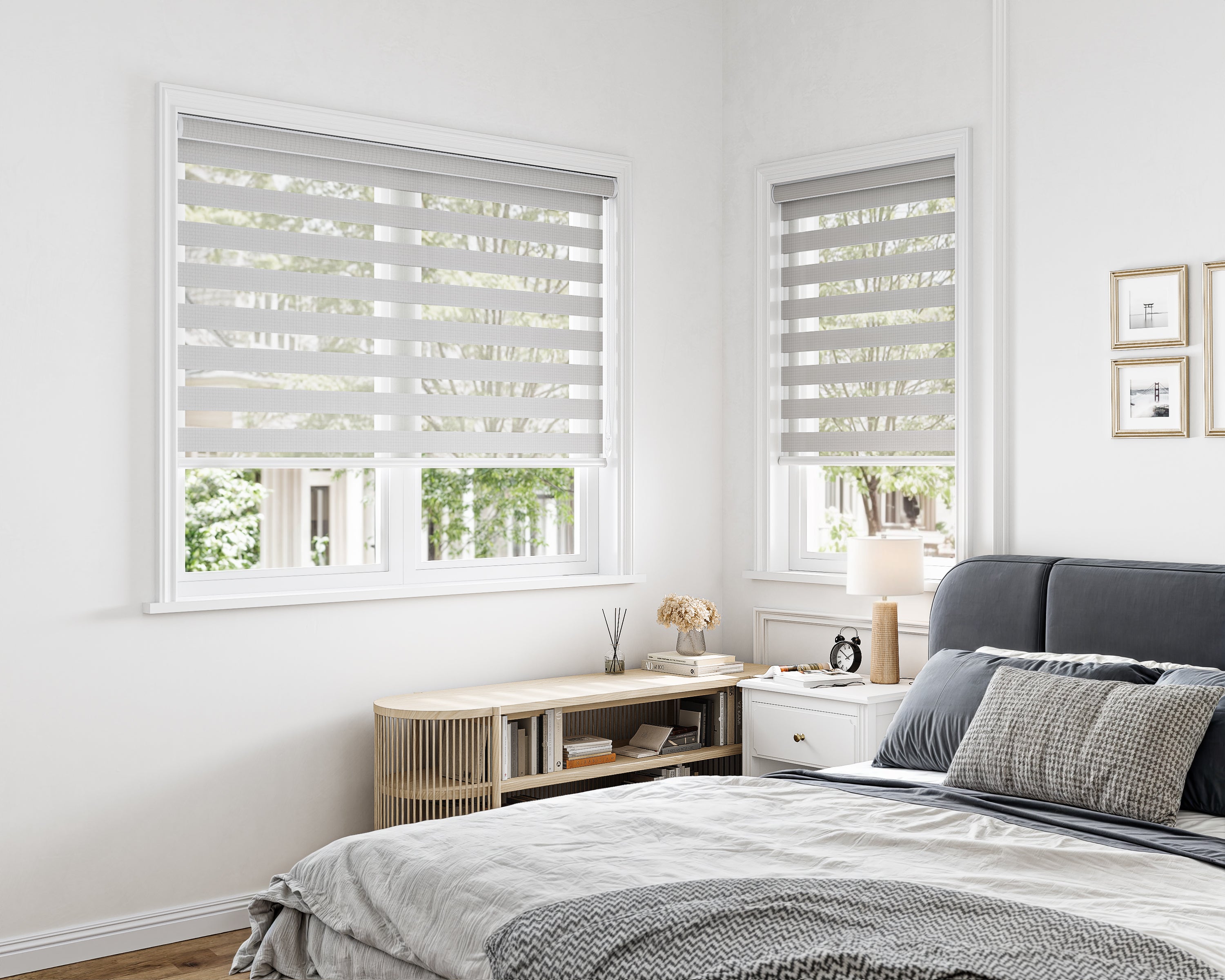
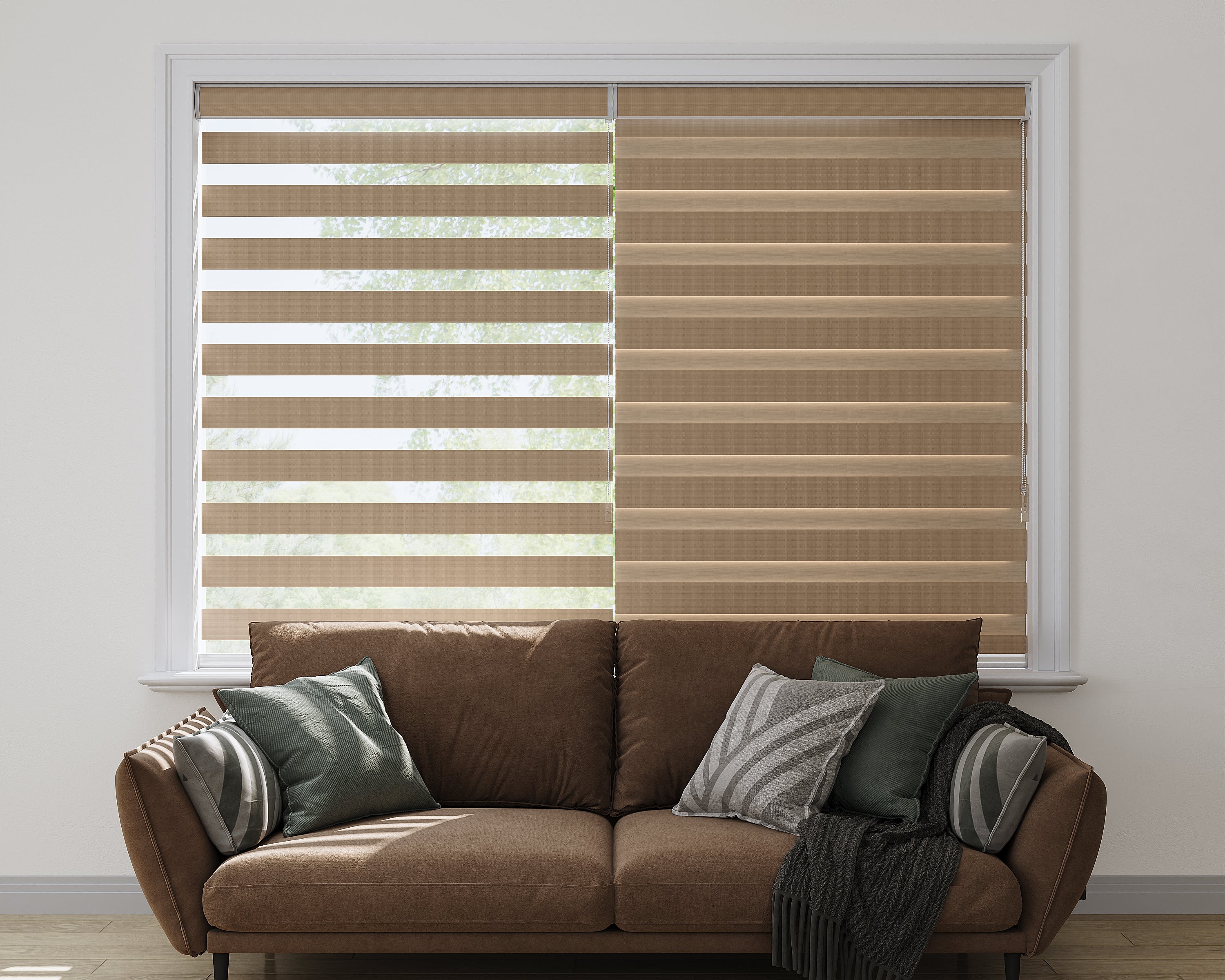







The most durable zebra shade fabrics are engineered from 100% polyester with a high GSM (grams per square meter) weight, a tight double-layer weave, and professional-grade protective treatments for UV, stain, and moisture resistance. True longevity is a product of material science, not just aesthetics. It requires understanding how synthetic composition, fabric density, and chemical finishes work together to resist daily wear, environmental stress, and the passage of time. To see and feel the difference that quality construction makes, begin your search with our collection of high-performance zebra blinds and shades.
This definitive guide provides the technical depth needed to make a truly informed purchase. Here’s what you’ll learn:
-
Why 100% polyester is the undisputed champion for strength, color stability, and resistance to humidity compared to natural fibers.
-
How to interpret technical specs like GSM and weave density, and the minimum thresholds you should look for to ensure tear resistance and prevent sagging.
-
The critical role of invisible fabric treatments that block UV rays, inhibit mold, and repel stains, actively preserving the fabric for over a decade.
-
A room-by-room specification guide to match fabric durability to environmental threats like intense sun, bathroom humidity, or high-traffic handling.
-
Proven maintenance protocols that protect your investment, ensuring the mechanisms and fabrics operate smoothly for years.
By the end, you will be equipped to evaluate zebra shades based on the engineering metrics that guarantee durability, transforming your choice from a decor update into a long-term investment for your home.
The Engineering of Durable Zebra Shade Fabrics
Durability in window treatments is a measurable science. It encompasses resistance to physical wear (tearing, fraying), environmental degradation (UV fading, mold), and functional failure (loss of opacity, band misalignment). The foundation is built on four technical pillars.
Key Technical Pillars of Durable Zebra Shade Fabrics
| Pillar | Ideal Specification | Impact on Durability | How to Verify |
|---|---|---|---|
| Material Composition | 100% Polyester | Superior dimensional stability, colorfastness, and resistance to moisture/mildew vs. natural fibers. | Request fabric composition data from the manufacturer. |
| Fabric Weight (GSM) | 300-350 GSM for opaque bands; 200+ GSM for sheer bands. | Higher GSM indicates denser, thicker fabric that resists tearing, stretching, and sagging, especially on wide windows. | Ask for the GSM rating of both the sheer and opaque sections. |
| Weave & Construction Quality | Tight, double-layer woven construction on specialized looms. | Prevents seam separation, stripe misalignment, and fabric fraying. Ensures smooth, consistent operation for years. | Inspect a sample's cut edge for fraying and check for perfect, uniform stripe alignment. |
| Protective Treatments | UV stabilizers, antimicrobial coatings, soil-resistant finishes. | Blocks >98% UV rays to prevent fading; inhibits mold in damp areas; repels dust and stains for easier upkeep. | Inquire about specific treatments (e.g., UPF 50+ for UV) and their expected lifespan. |
Material Composition: The Case for 100% Polyester
Zebra shade fabric is predominantly 100% polyester, and for compelling engineering reasons. Polyester is a synthetic polymer fiber engineered for performance, offering distinct advantages over natural alternatives.
-
Dimensional Stability: Unlike cotton or linen, polyester is hydrophobic, meaning it absorbs minimal moisture from the air. It will not expand, contract, or warp with seasonal humidity changes. This stability is critical for maintaining the precise alignment of sheer and opaque bands over thousands of adjustments, a common failure point in poorer quality shades.
-
Colorfastness & UV Resistance: Premium polyester fabrics are often solution-dyed, meaning pigment is embedded within the molten fiber before it is extruded. This makes the color integral to the material, not just a surface coating. When combined with UV-inhibiting treatments, this allows colors to remain vibrant for 8-10 years or more, even in south-facing windows. This is a key difference between long-lasting and disposable window treatments.
-
Inherent Resistance: Polyester naturally resists water, many household chemicals, and mildew, providing a baseline of protection that makes it suitable for a wider range of environments. For areas like bathrooms or kitchens, this inherent resistance is bolstered by specific moisture-resistant fabric treatments designed for kitchens and baths.
Fabric Weight and Weave: The Blueprint for Structural Integrity
The physical construction of the fabric is its load-bearing framework. Two key metrics define this: GSM and weave integrity.
-
GSM (Grams per Square Meter): This is the single most telling specification for physical durability. It measures the mass of the fabric per unit area. Light-duty fabrics (200-250 GSM) are suitable for small, low-traffic windows but may stretch or show wear patterns under frequent use. Durable, residential-grade fabrics start at 280-300 GSM for the opaque bands, with premium and commercial-grade options reaching 350 GSM or higher. This denser material resists poking from pets or children, prevents sagging on wide window spans, and withstands wear at the points where the shade is touched or handled.
-
Weave Quality & Double-Layer Construction: High-quality zebra shades are not two separate fabrics glued together. They are woven on specialized looms that create the alternating sheer and opaque bands as a single, continuous double-layer fabric. This integrated construction is superior to laminated alternatives, as it eliminates delamination—a failure where layers separate—and ensures the stripes remain perfectly aligned for the life of the shade. The precision of this weave also prevents fraying along the cut edges.
Protective Treatments: The Invisible Shield Against Decay
Beyond the base fabric, professional chemical treatments are applied to actively combat the elements and prolong life. These are not mere marketing terms but essential components.
-
UV Stabilizers & UPF Rating: Continuous sun exposure is the primary agent of fabric degradation. Treatments that provide a UPF 50+ rating block over 98% of harmful UV-A and UV-B radiation. This protection is crucial not only for preventing the fabric's colors from fading but also for stopping the polymer fibers themselves from becoming brittle and weak over time.
-
Antimicrobial & Soil-Resistant Finishes: These targeted treatments address specific environmental threats. Antimicrobial coatings prevent mold and mildew spores from taking root in the fabric, which is vital for humid areas. Soil-resistant finishes, often fluorochemical-based, create a microscopic barrier that causes dust, oils, and light stains to bead up on the surface rather than being absorbed into the fibers. This makes routine maintenance far more effective and is a key feature for maintaining the clean, professional look of shades in a home office.
Selecting Fabrics for Specific Environmental Threats
Durability is not one-size-fits-all. The demands on a shade in a sunny living room are different from those in a steamy bathroom. Use this guide to match fabric specifications to your room's unique challenges.
For High-Sun & South/West-Facing Windows
-
Primary Threat: Ultraviolet (UV) radiation and infrared (IR) heat leading to rapid photodegradation of fibers and dyes.
-
Mandatory Specifications: Maximum UV protection is non-negotiable. Look for a stated UPF 50+ rating. Opt for darker colors (charcoal, navy, black), as darker pigments naturally absorb and dissipate more UV energy than light, reflective colors. A high GSM rating (300+) provides the structural mass to better withstand thermal expansion and contraction.
For High-Humidity Areas (Bathrooms, Kitchens, Coastal Homes)
-
Primary Threat: Moisture absorption leading to mold, mildew, fabric warping, and metal component corrosion.
-
Mandatory Specifications: 100% polyester is essential due to its low moisture absorption rate. Explicit antimicrobial or moisture-resistant treatments should be confirmed. For motorized shades in these environments, ensure the motor has an appropriate ingress protection rating. Understanding how motorization works and its benefits is key for these applications.
For High-Traffic & Child-Friendly Spaces
-
Primary Threat: Physical abrasion, frequent handling, contact with hands, and potential impact.
-
Mandatory Specifications: Prioritize maximum fabric weight (300-350 GSM) to resist pilling, tearing, and deformation. Soil-resistant finishes are critical for easy cleaning of fingerprints and smudges. A cordless or motorized lift system is highly recommended to eliminate cords that can cause wear from pulling and to enhance safety. The inherent safety and cleanliness of these systems are a major durability advantage.
Maintenance Protocols to Maximize Fabric Lifespan
Even the most durable fabric requires intelligent care. These protocols are designed to preserve both the physical fibers and the protective chemical treatments.
-
Regular, Gentle Dusting: Use a vacuum cleaner with a soft brush attachment on a low suction setting weekly or bi-weekly. This prevents a layer of abrasive dust from building up, which can microscopically scratch fibers and trap moisture.
-
Correct Spot Cleaning: For stains, use a soft, white microfiber cloth dampened with a solution of lukewarm water and a few drops of pH-neutral dish soap. Always blot gently; never scrub or use circular motions. Scrubbing can break the surface fibers and degrade soil-resistant coatings. Always test any cleaner on a hidden corner first.
-
Avoid Destructive Cleaning Methods: Never immerse, steam clean, or machine wash zebra shades. These methods will cause irreversible damage: water can disintegrate internal components, steam can melt adhesives and warp fabrics, and agitation will destroy the weave. These actions void manufacturer warranties.
-
Operational Care for Longevity: Operate shades smoothly and evenly. For manual shades, avoid yanking the bottom rail. For motorized shades, keep batteries charged or replaced to prevent the motor from straining, which can cause misalignment and uneven wear on the fabric.
Conclusion: Investing in Engineering for Decades of Performance
Selecting a durable zebra shade fabric is a deliberate choice to invest in engineering over ephemeral style. It requires looking past the initial color and pattern to evaluate the proven metrics that predict longevity: the synthetic, stable composition of 100% polyester, the substantial density indicated by a high GSM, the precision of a unitary double-layer weave, and the active defense provided by professional treatments.
By specifying these technical criteria and adhering to simple, consistent maintenance, you can expect high-quality zebra shades to provide 10-15 years or more of flawless performance. This approach transforms a window treatment from a decorative accessory into a durable, functional asset of your home.
Key Highlights
-
Durability starts with 100% polyester for unmatched stability, color retention, and moisture resistance.
-
Fabric weight (GSM) is a critical indicator; seek 300+ GSM for opaque bands to ensure resistance to sagging and physical damage.
-
Protective treatments (UV, antimicrobial, soil-resistant) are essential, not optional; they are the active shields that combat the primary causes of fabric decay.
-
Match fabric specs to room environment: Prioritize UV protection for sunny rooms and antimicrobial finishes for humid spaces.
-
Proper care preserves integrity: Gentle, regular dusting and correct spot cleaning are essential to maintain both the fabric's appearance and its protective treatments.
Explore Custom Zebra Shades


Frequently Asked Questions (FAQ)
What is the difference between "blackout" fabrics and durable fabrics?
Blackout refers to a fabric's ability to block light, achieved through tight weaves, density, and sometimes opaque backings. Durability refers to the fabric's physical strength and longevity. A high blackout percentage often requires a denser fabric (higher GSM), which can contribute to durability. However, you must still verify the core material (polyester) and protective treatments separately, as a dense but untreated natural fiber will not be durable.
Can I get a durable zebra shade that looks like linen or another natural fabric?
Yes, and this is a smart way to get the aesthetic you want with the performance you need. Look for 100% polyester fabrics that are texturally engineered to mimic linen, cotton, or silk. These fabrics use advanced weaving techniques to create the visual texture and feel of natural materials while providing all the benefits of synthetic stability, colorfastness, and ease of care. Avoid blends with actual natural fibers if your priority is maximum durability.
How does choosing a motorized system impact fabric durability?
Motorization can significantly enhance fabric longevity, especially for large or frequently adjusted shades. By eliminating daily manual pulling and tugging on the bottom rail, motorized operation reduces physical stress and friction on the fabric edges, hem, and lift mechanisms. It ensures smooth, even movement every time, which prevents the twisting or misalignment that can lead to uneven wear and tear. For a detailed look at this trade-off, our comparison of cordless versus motorized lift mechanisms covers the operational benefits.
Is a longer warranty a reliable indicator of fabric durability?
Generally, yes. A manufacturer's warranty period reflects their confidence in the material's performance. Warranties on premium zebra shades often cover fabric integrity against fading, tearing, and defects for 5 to 7 years, sometimes longer. A strong, transferable warranty is a good proxy for quality. However, always read the fine print to understand what is covered (e.g., fading to a certain degree) and the actions that may void it (like improper cleaning).
